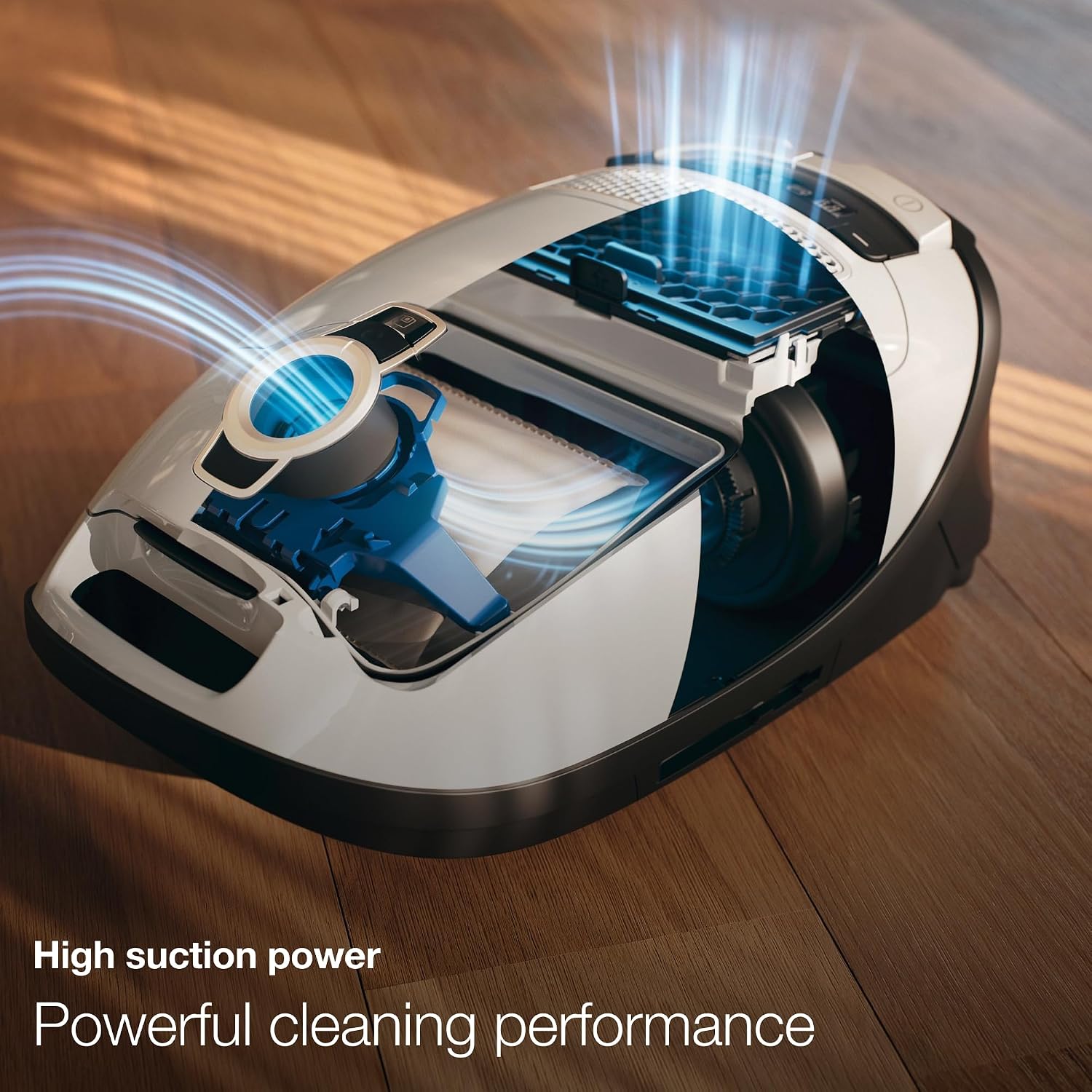
A canister vacuum is exactly what it sounds like: the motor and dust bin live in a separate canister (the rolling body you drag behind you), connected by a hose to the cleaning wand you actually push across the floor. That separation makes canisters lighter to steer than upright vacuums, easier to maneuver under furniture, and generally quieter. The category spans from sub-$60 bare-bones units to $583-and-up German-engineered machines, and the price gaps are not just marketing — they reflect real differences in filtration quality, motor longevity, and total cost of ownership. This guide names those differences tier by tier, shows you the cost math, and ends with a clear decision rule so you can stop second-guessing the purchase on your desk right now.
| EDITOR'S PICK[Miele Blizzard CX1 Turbo Team B…](https://www.amazon.com/dp/B079PN6RHZ?tag=greenflower20-20) | Mid-tier[Kenmore 81214 200 Series Pet Fr…](https://www.amazon.com/dp/B075F4YTVF?tag=greenflower20-20) | Budget pick[Bissell Zing Lightweight](https://www.amazon.com/dp/B075PL2GDD?tag=greenflower20-20) | |
|---|---|---|---|
| Bag Type | Bagless | Bagged | Bagged |
| Pet Tools | — | ✓ | — |
| HEPA Filter | — | ✓ | — |
| Motor Count | — | 2 | — |
| Price | $583.20 | $194.99 | $89.99 |
| See on Amazon → | See on Amazon → | See on Amazon → |
How the Canister Market Actually Breaks Down
The canister market in mid-2026 segments cleanly into four bands. Understanding what’s actually changing across those bands — not just what the box says — is the whole game.
By the numbers:
| Tier | Price range | Filtration standard | Expected motor life | Bag or bagless |
|---|---|---|---|---|
| Budget | $58–$120 | Foam/basic filter | 2–4 years | Usually bagless |
| Mid-range | $130–$280 | HEPA-style or certified HEPA | 4–7 years | Both |
| Premium consumer | $300–$450 | Sealed HEPA or AirClean | 8–12 years | Bagged |
| Prosumer/commercial | $451–$583+ | Certified sealed system + HEPA | 15–20 years | Bagged |
“HEPA” is the term worth unpacking before anything else, because it’s used loosely enough to cause real buying mistakes. A true HEPA filter — the standard set by the U.S. Department of Energy — captures 99.97% of particles at 0.3 microns. That’s the threshold that matters for allergens, fine dust, and respirable particles. But “HEPA-style” and “HEPA-type” filters on budget units are marketing language, not a certification. They may capture 85–95% of particles at best. If you’re cleaning for anyone with asthma, allergies, or in a healthcare-adjacent setting, that gap is meaningful. ISSA’s Cleaning Industry Management Standard filtration guidance explicitly distinguishes between certified HEPA filtration and HEPA-adjacent marketing claims — a distinction most box-store packaging buries.
The second variable that separates tiers is sealed system design. A vacuum can have a legitimate HEPA filter and still exhaust unfiltered air if the housing has gaps around the filter or bag port. Sealed systems ensure all exhaust air passes through the filter, not around it. Below $200, sealed systems are rare. Above $400, they’re standard on reputable brands.
What You’re Actually Buying at Each Tier
Budget ($58–$120): The Honest Case For and Against
Budget canisters — think generic house-brand units from mass retailers or entry Eureka/Bissell models in this range — aren’t fraudulent. For a small apartment with hard floors and no serious allergen concern, they do the job. Bagless designs keep ongoing costs near zero, which matters if you’re running slim margins on residential contracts or just starting out and watching every dollar.
The real costs show up over time. Owners of budget canisters in aggregated reviews consistently flag two patterns: suction loss within 18 months as foam filters degrade and resist cleaning, and brittle plastic hose joints that crack under repeated bending. Wirecutter’s canister vacuum guidance notes that budget units typically lack self-sealing hose connections, meaning the suction path leaks before the filter even becomes the limiting factor.
For a residential cleaning operator doing 4–6 jobs per week, that 18-month degradation curve means a replacement purchase every two years. At $90/unit, that’s $45/year in hardware — before you factor in the time cost of a vacuum that’s losing suction on the back half of your shift. The math isn’t automatically wrong, but it needs to be run honestly.
Best fit: Single-person apartment, low-traffic hard floors, no allergy or IAQ (indoor air quality) requirements, or as a dedicated secondary vacuum for a specific task.
Mid-Range ($130–$280): Where Most Buyers Should Start the Conversation
This is the most crowded and most confusing tier, because it’s where “HEPA-style” branding peaks and where you have to read specs carefully. Brands like Kenmore, Shark, and Hoover all have strong presences here, and some units genuinely deliver certified HEPA filtration while others don’t.
Good Housekeeping Institute’s canister vacuum evaluation notes that mid-range units in the $180–$250 band often carry the best airwatt-to-price ratios in the market. Airwatts — a measure of combined suction and airflow, calculated as (CFM × Water Lift) ÷ 8.5 — are a more honest proxy for real-world cleaning performance than raw wattage, which only tells you how much electricity the motor draws, not how effectively it moves air and debris.
Look for: true HEPA certification (not “HEPA-type”), a dust bag rather than a bagless cyclone if you’re cleaning regularly and want filtration stability over time, and a minimum 6-foot hose — shorter hoses on budget-tier units routinely frustrate stair and under-furniture cleaning.
Consumer Reports’ 2025 vacuum buying guide identifies the mid-range segment as where bagged canisters begin to outperform bagless on total filtration efficiency over time, largely because bags themselves act as a secondary filter medium and contain dust at disposal rather than releasing it.
Best fit: Homeowners with carpet and hard floors, residential cleaning operators building a reliable tool kit, or anyone with mild allergy concerns who needs certified (not marketing-copy) filtration.
Premium Consumer ($300–$450): The Miele C1/C2 Zone
At $300–$450, you’re primarily looking at Miele’s Complete C1 and C2 series, and a few Bosch and Sebo entries. This is where the sealed system design becomes standard and where the total cost of ownership math genuinely shifts.
Miele’s AirClean filtration system — documented in Miele’s own technical specification literature — combines a self-sealing dust bag with a motor protection filter and an exhaust filter rated to retain 99.9% of fine dust. The bags are designed to seal at removal, so you’re not releasing a cloud of captured allergens into the air when you swap them. That’s not a marketing claim; it’s an engineering feature with a functional mechanism.
Motor longevity is the other variable. Miele publishes a 20-year average motor lifespan figure for their C-series, based on internal testing at 1,000 hours of use. Independent owner reviews bear this out — it’s common to find C1 owners on appliance forums reporting 10–14 years of continuous residential use with no motor service. Consumer Reports’ ratings consistently place Miele near the top of predicted reliability scores in the canister category.
The ongoing cost is real: Miele AirClean bags run roughly $5–$7 each, and a household going through one bag per month spends $60–$84/year on consumables. A cleaning operator running 30+ jobs per week will go through bags faster. At scale, that’s a line item — but it’s a predictable one, unlike motor replacements or hose failures on cheaper units.
Best fit: Allergy households, design-conscious buyers who want a machine that lasts a decade, and residential cleaning operators who’ve done the cost-per-use math and found the bag cost acceptable relative to replacement cycles.
Prosumer/Commercial ($451–$583+): The Miele Complete C3 and Compact C2 Territory
The Miele Complete C3 — which lands in the $500–$583 range depending on the bundle configuration — is the machine most frequently cited when facilities managers and high-end residential operators ask “what’s the ceiling for a canister vacuum before you move to commercial-specific equipment?”
The C3’s upgrades over the C2 are incremental but targeted. The footprint is larger, the hose diameter is wider (improving airflow on deep-pile carpet), and the C3 Alize and Brilliant configurations include an electrobrush (a motorized brush roll in the floor head, powered separately from the main suction) — the spec that matters most on thick carpet or area rugs where suction alone won’t dislodge embedded debris.
The C3 also accepts Miele’s HEPA AirClean 50 filter, which adds a second layer of certified HEPA filtration at exhaust — relevant for operators cleaning in spaces where occupant health is a formal concern (senior living facilities, medical offices, schools). ISSA’s CIMS documentation identifies exhaust-side HEPA filtration as a best-practice specification for cleaning in sensitive environments.
At $583, the C3 sits just below the threshold where you’d start evaluating purpose-built commercial canisters from Nilfisk or Proteam. The C3 is not rated for the duty cycles a full commercial program demands — Miele’s documentation is clear that the C-series is designed for residential use, not sustained 8-hour-per-day operation. If you’re running a commercial contract with daily full-shift use, the C3 will serve well but will likely need motor service sooner than its residential lifespan estimate suggests.
The Decision Rule: If X, Then Y
This is where practitioners get stuck: the options are close enough that the decision feels arbitrary. It isn’t. Here’s the framework:
If your primary concern is per-job cost control and you’re in year one of a residential operation: Start at mid-range ($180–$250) with a certified HEPA bagged canister. Don’t let the $300 gap to Miele feel like the right austerity move — budget units below $120 will cost you more in replacement cycles and lost suction time than the price difference saves.
If you’re cleaning 15+ residential jobs per week and have 12+ months of contract stability: The Miele C2 or C3 is the correct calculation. Annualize the cost over eight years of motor life, subtract the replacement cycles you won’t be doing, and the premium largely pays itself. Owners running residential cleaning businesses consistently report that premium canisters reduce mid-job frustration (lost suction, broken hose clips) enough to meaningfully affect per-job time.
If you have a documented allergen or IAQ requirement in your contract: The sealed HEPA system is not optional — it’s a specification. Miele C2 minimum; C3 with HEPA AirClean 50 filter for sensitive environments. “HEPA-style” filtration in a non-sealed housing does not meet this bar regardless of what the packaging says.
If you’re evaluating canisters for sustained commercial duty (daily 6–8 hour use): The C3 is a ceiling, not a floor. At that usage intensity, look at purpose-built commercial units — Nilfisk’s GD Series or Proteam’s canister lineup — before committing working capital to a residential-rated machine.
If you’re a homeowner with hard floors, no allergy concerns, and a tight budget: A $180–$220 mid-range certified HEPA canister is genuinely sufficient. The Miele premium is real, but it’s not universally justified — buying more machine than your use case requires is its own kind of waste.
The canister vacuum market rewards buyers who read past the box. The filtration standards, sealed-system design, and motor longevity specs are all documented — you just have to look at them before the purchase, not after.