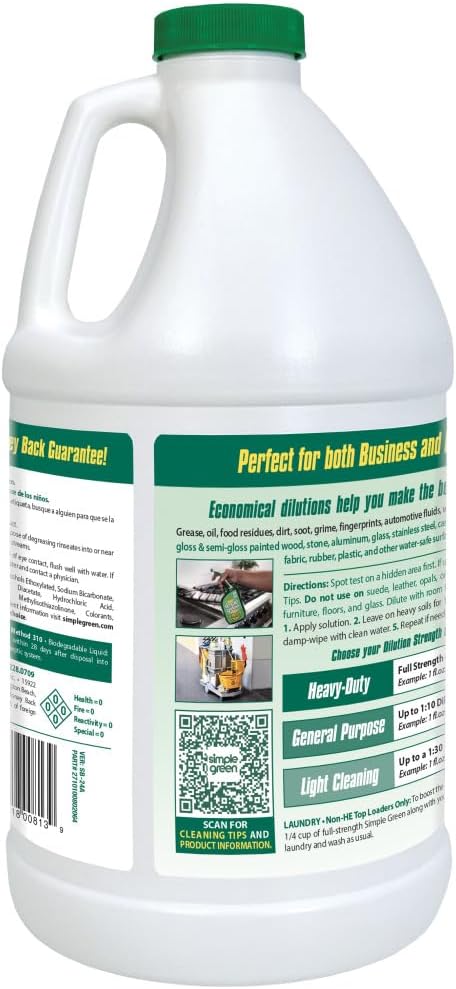
If you’ve ever grabbed a bottle of all-purpose cleaner off a shelf and winced at the price, you’ve probably wondered whether the concentrates — the ones that promise to make dozens of bottles from a single jug — are actually worth it. A concentrate is exactly what it sounds like: a cleaning formula where much of the water has been removed, so you add your own at home or on-site according to a dilution ratio (the manufacturer’s instruction for how many parts water to mix with one part product). A 1:32 ratio, for example, means one ounce of concentrate mixed with 32 ounces of water. The savings are real — but only if you do the math correctly before you buy. Get the ratio wrong in either direction and you’re either wasting money or leaving surfaces under-cleaned. This guide walks through exactly how to calculate your true cost-per-use (the actual dollar amount you spend each time you spray and wipe a surface), compares the numbers across four common price and format tiers, and gives you a clear decision rule for where your next dollar should go.
| EDITOR'S PICKDr. Bronner's Sal Suds Biodegra… | Mid-tier[Simple Green Pro HD Heavy Duty…](https://www.amazon.com/dp/B00103YQ88?tag=greenflower20-20) | Budget pick[Fabuloso Multi-Purpose Cleaner](https://www.amazon.com/dp/B0FD26Y4N5?tag=greenflower20-20) | |
|---|---|---|---|
| Concentrate ratio | — | — | 2X |
| Volume (oz) | 128 | 128 | 56 |
| Scent | Fir & Spruce | — | Lemon |
| Biodegradable | ✓ | — | — |
| Laundry use | ✓ | — | — |
| Price | $54.99 | $15.58 | $4.97 |
| See on Amazon → | See on Amazon → | See on Amazon → |
Why the Sticker Price Lies to You (and How Dilution Ratio Fixes That)
The bottle price is almost meaningless without the dilution ratio. A $28 quart of Method Concentrated Cleaner at a 1:9 dilution yields ten quarts of ready-to-use (RTU) product — meaning you’re paying $2.80 per finished quart. A $12 bottle of a conventional RTU cleaner costs $12 per quart. The concentrate looks expensive on the shelf and is dramatically cheaper in use.
But concentrates vary wildly in their ratios. Consumer-facing formulas sold at natural grocery chains and big-box stores typically land between 1:3 and 1:32. Professional and janitorial-grade concentrates — products like Spartan Chemical’s BioRenewables line or Betco’s line of dilution-control concentrates — routinely run 1:64, 1:128, or even 1:256. At those ratios, a single gallon of chemistry can yield 32 to 64 gallons of working solution.
That difference is why comparing concentrate SKUs by price per ounce of concentrate is still misleading. The only number that matters for budgeting is cost per finished ounce of ready-to-use solution (or cost per spray bottle, if that’s how your crew works).
The Math, Shown Once So You Can Repeat It
Here’s the formula:
Cost per RTU ounce = (Concentrate price ÷ Concentrate volume in oz) ÷ (Dilution ratio + 1)
Walk through an example with Seventh Generation Professional Concentrated Cleaner, which spec sheets list at a 1:9 dilution and sells in a 32 oz bottle for approximately $14 (2026 retail):
- Price per ounce of concentrate: $14 ÷ 32 = $0.4375/oz
- Dilution multiplier: 1:9 means each ounce of concentrate becomes 10 oz of RTU (1 part product + 9 parts water)
- Cost per RTU ounce: $0.4375 ÷ 10 = $0.044/oz
- A standard 32 oz spray bottle costs: 32 × $0.044 = $1.40 per refill
Now run the same math on a commercial-grade 1:128 product — say, a 1-gallon jug priced at $22:
- Price per ounce of concentrate: $22 ÷ 128 = $0.172/oz
- Dilution multiplier: 1:128 means each ounce yields 129 oz RTU
- Cost per RTU ounce: $0.172 ÷ 129 = $0.0013/oz
- A 32 oz spray bottle costs: 32 × $0.0013 = $0.042 per refill
That’s the math that motivates janitorial contractors to run dilution-control dispensers. At commercial volume — filling 50 spray bottles a week — the difference between $1.40 and $0.04 per refill works out to roughly $3,640 per year in chemistry savings alone.
By the Numbers: Four Tiers, One Honest Comparison
| Format | Example | Dilution | Approx. retail | Cost/32 oz RTU bottle |
|---|---|---|---|---|
| RTU (no dilution) | Generic store-brand | 1:0 | $4.00/32 oz | $4.00 |
| Consumer concentrate | Method Squirt + Mop | 1:9 | $8.00/25 oz | ~$0.88 |
| Prosumer concentrate | Seventh Generation Pro 32 oz | 1:9 | $14.00/32 oz | ~$1.40 |
| Commercial 1:128 | Spartan BioRenewables 1 gal | 1:128 | $22.00/128 oz | ~$0.04 |
Prices reflect mid-2026 averages from distributor and retail channels. Your local pricing will vary; run the formula above with your actual invoice price.
What You’re Actually Comparing When You Compare Products
Price and dilution ratio get you to cost-per-use. But three other variables determine whether the math translates into real-world value.
1. Certification Legitimacy
“Eco-friendly” is marketing copy. Two third-party standards do the actual verification work, and it’s worth knowing which one you’re dealing with.
The EPA Safer Choice label (administered under the EPA Safer Choice Program, per the Safer Choice Standard 2023 Edition) means every ingredient in the formula has been evaluated for human health and environmental impact. The program maintains a public searchable database; you can look up any product by name or EPA registration number and confirm current certification status. This matters because certifications lapse — a product that earned the label in 2022 may not have renewed it.
Green Seal GS-37 (Green Seal’s standard for industrial and institutional cleaning products, Edition 4.0) applies stricter performance requirements on top of environmental criteria and is the more common certification in commercial janitorial specifications. If your facility contract requires GS-37 compliance, a consumer EPA Safer Choice product won’t satisfy the spec even if it’s greener in some dimensions.
When reviewing products for this guide, we cross-referenced manufacturer claims against the EPA Safer Choice searchable database and Green Seal’s certified product list — both publicly available. Several products marketed with environmental language did not appear on either list as of May 2026.
2. Dilution Accuracy in Practice
The ISSA’s Value of Clean Report (2024 edition) cites product misuse — primarily incorrect dilution — as one of the top causes of cleaning chemistry cost overruns in commercial settings. Over-diluting reduces efficacy; under-diluting wastes chemistry and can leave residue that attracts soil faster (a phenomenon sometimes called “rapid re-soiling”).
Operators with fewer than six months of chemical management experience consistently underestimate this. If your team is hand-measuring concentrate into spray bottles, expect 15–30% dilution variance, per documentation from Spartan Chemical’s professional dilution control white paper. Dilution-control dispensers (wall-mounted systems that meter concentrate automatically) reduce that variance to under 5%. At commercial volume, that accuracy gap is worth more than the cost of the dispenser within the first quarter.
3. Fragrance, pH, and Surface Compatibility
Most all-purpose concentrate formulas are pH-neutral to mildly alkaline (pH 7–10). That range handles the majority of general-purpose soils — grease, light grime, food residue — on sealed hard surfaces. It’s the right range for daily use.
Problems arise when operators use an all-purpose at the wrong pH for the task. Alkaline cleaners (pH 10+) cut grease well but can damage natural stone, aluminum, and some finished wood. Acidic cleaners (pH < 6) dissolve mineral scale and hard water deposits but attack grout and many metals. If you’re sourcing one product to handle a wide range of surfaces across a facility, confirm the pH range on the safety data sheet (SDS) — not the marketing label. The SDS is required by OSHA’s Hazard Communication Standard (29 CFR 1910.1200) and will name the pH, active ingredients, and surface restrictions that the front label typically omits.
The Decision Frame: Which Tier Actually Makes Sense for You
This is where the math gets applied to your situation. There’s no universal winner; there’s only the right answer for your volume, your compliance requirements, and your operational discipline.
If you’re a residential cleaning operator with 10–25 clients and you’re currently buying RTU product in 32 oz bottles at retail: switching to a consumer-grade concentrate (1:9 to 1:32) will cut your chemistry cost by 50–75% with no operational change other than keeping a measuring cup in your supply kit. The EPA Safer Choice label is a meaningful differentiator here if your clients are asking about it — and more are, per the ISSA 2024 report on client purchasing criteria. Products in the Method Professional and Seventh Generation Professional lines carry that certification as of May 2026; verify current status against the EPA database before making a compliance claim to a client.
If you’re managing 25+ recurring accounts or a commercial facility and you’re not yet using a dilution-control dispenser: that’s where your next dollar should go before you optimize chemistry SKUs. The dispenser pays back in dilution accuracy and labor (no measuring) faster than switching brands. Then move to commercial 1:64 or 1:128 concentrates through a jan-san distributor. At that dilution, a Grainger or Zoro order of four 1-gallon jugs at roughly $22 each covers approximately 512 gallons of RTU product — enough for a mid-size facility running daily cleaning for three to four months.
If you’re bidding a new commercial contract with a green-building or LEED-certification component: GS-37 compliance is typically the specified standard, not EPA Safer Choice. Confirm the contract language. Bidding with the wrong certification tier can create liability if the facility is audited. Green Seal’s certified product list (publicly searchable on the Green Seal website) is the authoritative source.
If your decision is purely residential or prosumer — you’re a homeowner or apartment dweller who wants to stop buying plastic RTU bottles and actually save money — the Method Squirt + Mop concentrate line and Seventh Generation’s Multi-Surface Concentrate both hit the EPA Safer Choice threshold, dilute at practical ratios for household use, and run under $1.50 per filled spray bottle based on published dilution specs. That’s a clear win over RTU on both cost and plastic reduction.
A Note on What We Know and How We Know It
The cost-per-use figures in this guide are calculated from published dilution ratios and mid-2026 retail and distributor pricing — not from lab testing or direct product use. Where we reference certification status, we’ve described the verification method (EPA Safer Choice database, Green Seal certified product list) so you can confirm it yourself before a purchasing decision or client conversation. Chemistry prices fluctuate; run the formula above with your actual invoice price, and the math takes care of itself.
The one thing no math replaces: reading the SDS before you buy a new chemistry SKU. It’s one page. It tells you pH, surface restrictions, skin and respiratory precautions, and dilution guidance. If a supplier can’t provide the SDS before the sale, that’s your answer on whether to work with them.