Walk into any custodial closet in America — apartment building, small office, daycare — and you’ll almost certainly find at least one of these three: Fabuloso, Mr. Clean, or Pine-Sol. They’re inexpensive, smell familiar, and come in sizes ranging from a 22-oz bottle under $3 to a 175-oz jug. But here’s the thing that catches a lot of operators off guard: cleaning and disinfecting are legally distinct terms, and only one product in this trio is EPA-registered to actually disinfect surfaces under normal use conditions. The other two remove dirt and make surfaces smell clean — which matters — but they don’t carry the federal registration that guarantees pathogen reduction on contact. If you’re writing a scope of work, responding to a health-department inspection, or just trying to figure out whether you’re actually killing germs or just moving them around, the distinction is the whole ballgame.
This guide breaks down each product’s label claims, correct dilution ratios, real-world cost-per-use math, and the specific use cases where each one earns its place — or doesn’t.
The Core Difference: Cleaner vs. Disinfectant (and Why the EPA Is the Referee)
A cleaner removes soil, grease, and organic matter from surfaces. A disinfectant kills or inactivates a defined percentage of specific pathogens — bacteria, viruses, fungi — on a pre-cleaned surface within a specified contact time. A product can only legally claim to disinfect if it holds an EPA registration number under the Federal Insecticide, Fungicide, and Rodenticide Act (FIFRA). That registration ties the claim to a specific formulation, concentration, and dwell time: how long the product must remain wet on the surface to produce the stated kill rate.
According to the U.S. EPA’s Selected EPA-Registered Disinfectants list (EPA.gov, Antimicrobial Products Registration), Pine-Sol Original — specifically the formulation listing pine oil as the active ingredient — carries an EPA registration number and may be labeled as a disinfectant when used at the concentration and dwell time specified on its label. Fabuloso Original and Mr. Clean Multi-Surface Cleaner do not appear on the EPA’s disinfectant registry. They are regulated as household cleaners, not antimicrobial products.
The Good Housekeeping Institute, in its multipurpose cleaner and disinfectant testing overview (goodhousekeeping.com), reinforces this distinction directly: fragrance and surface appearance after cleaning are not proxies for antimicrobial efficacy. A product can leave a surface smelling fresh without reducing pathogen load in any measurable way. This is not a knock on Fabuloso or Mr. Clean — both are excellent at what they are designed to do. But if your contract requires documented disinfection — healthcare-adjacent spaces, food-contact surfaces, childcare environments, or post-illness sanitation — you need a product that can produce an EPA registration number, a specific efficacy claim, and a required dwell time. Fabuloso and Mr. Clean cannot provide that documentation.
Dilution Ratios Compared: What the Labels Actually Say
Dilution ratio is the proportion of concentrate to water. Getting this wrong costs money in either direction: too weak and you’re not cleaning effectively; too concentrated and you’re wasting product, leaving residue, or — in the case of a registered disinfectant — potentially voiding the efficacy claim by straying outside the tested use-dilution range.
Fabuloso Original
Fabuloso’s standard cleaning dilution is approximately 1/4 cup per gallon of water, or roughly 1:64 (about 2 oz per gallon). Colgate-Palmolive publishes a range of use concentrations depending on surface type and soil load: 1:64 is the baseline for light maintenance, while heavily soiled surfaces may warrant a stronger mix closer to 1:32. For operators purchasing Fabuloso in 175-oz or gallon formats through club stores or janitorial distributors, calibrating a chemical dispenser to a consistent ratio is straightforward and pays off quickly at scale.
Fabuloso carries no EPA disinfectant registration. There is no concentration at which it becomes a disinfectant by federal definition. Its value proposition is maintenance cleaning and residual fragrance — the scent signal that clients and building occupants associate with a freshly cleaned space. That is a legitimate value, but it is a different value from pathogen control.
Cost at cleaning dilution (175-oz club-format jug, approximately $9): At 2 oz per gallon, yields roughly 87 gallons of working solution. Cost per gallon of solution: approximately $0.10. Cost per 32-oz spray bottle: approximately $0.02.
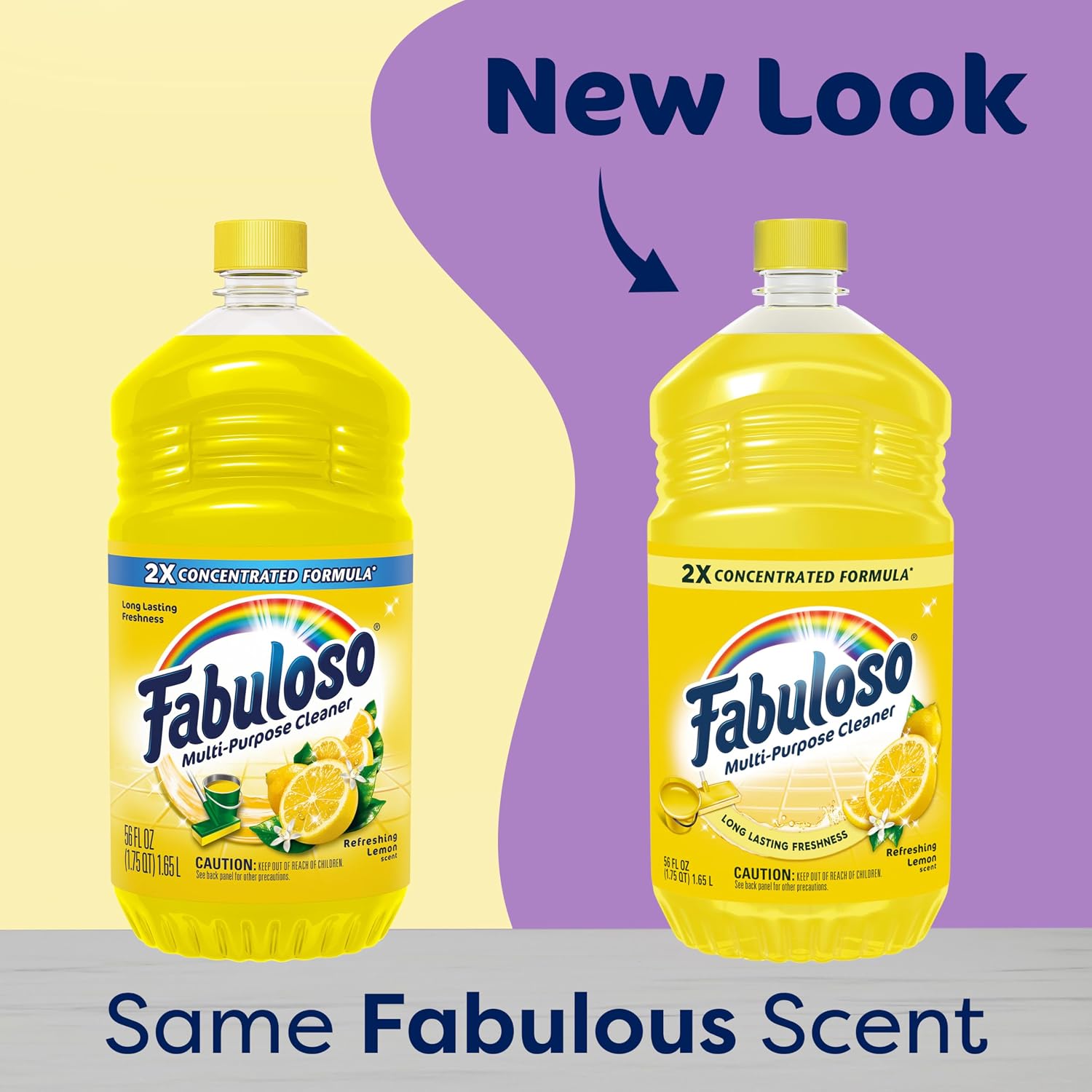
Fabuloso
$4.97
In stock on Amazon
Check price on AmazonMr. Clean Multi-Surface Cleaner
Mr. Clean’s consumer label instructs users to add approximately 1/4 cup to a bucket of water — a volume-based instruction that does not specify gallons, which makes precise ratio calibration harder in commercial contexts. Translated to a gallon-based ratio, the instruction approximates 1:64, similar to Fabuloso. Mr. Clean’s surfactant package is formulated for soap scum, light grease, and painted or sealed hard surfaces — bathroom fixtures, appliance exteriors, countertops. It rinses cleanly and leaves minimal residue on smooth surfaces.
Like Fabuloso, Mr. Clean Multi-Surface Cleaner carries no EPA disinfectant registration. It cannot be used to fulfill a documented disinfection requirement regardless of concentration. The ISSA Cleaning Industry Management Standard (CIMS), Chemical Management Module (issa.com), notes that chemical selection for infection-sensitive environments must be tied to verified kill claims and regulatory registration — a standard that consumer-positioned cleaners like Mr. Clean are not designed to meet.
Mr. Clean is not available in bulk concentrate formats competitive with Fabuloso’s club pricing, which limits its cost-per-use advantage at commercial scale. Its consumer-oriented label language is an operational advantage in one specific scenario: handing product to untrained staff. The bucket-fill instruction is legible without chemistry knowledge.
Cost at cleaning dilution (45-oz bottle, approximately $6): At 2 oz per gallon, yields approximately 22 gallons. Cost per gallon: approximately $0.27.
Fabuloso
$8.97
In stock on Amazon
Check price on AmazonPine-Sol Original
Pine-Sol Original is the only product in this comparison with an EPA antimicrobial registration. At the labeled cleaning dilution — approximately 1/4 cup per gallon (roughly 2 oz per gallon, or 1:64) — Pine-Sol functions as a cleaner, not a disinfectant. To reach the disinfecting threshold, the label specifies a higher concentration (approximately 3 oz per gallon, depending on the specific registered formulation) and a 10-minute wet dwell time. The surface must remain visibly wet for the full contact period; if it dries before 10 minutes have elapsed, the disinfection step has not been completed.
The CDC’s Guidelines for Environmental Infection Control in Health-Care Facilities (cdc.gov) make this point broadly and clearly: dwell time is a non-negotiable component of any disinfection protocol. A surface wiped down and immediately dried or walked over has been cleaned, not disinfected, regardless of what product was used. Operators running Pine-Sol disinfection protocols need a procedural enforcement mechanism — timed dwell, wet application method, and surface segmentation — to ensure the contact time requirement is consistently met.
One important operational note: Pine-Sol’s registered formulations have changed over time. The EPA registration is tied to a specific active ingredient and concentration. Before writing Pine-Sol into a disinfection protocol, verify that the specific SKU you are purchasing lists pine oil as the active ingredient and carries the EPA registration number on the current label. Not all Pine-Sol products in the current product line share the same registration status.
Cost at cleaning dilution (144-oz club-format jug, approximately $12): At 2 oz per gallon, yields approximately 72 gallons. Cost per gallon: approximately $0.17. At disinfecting dilution (3 oz per gallon): approximately 48 gallons. Cost per gallon at disinfecting use: approximately $0.25 — roughly 47% higher than cleaning dilution, a meaningful difference when running large-area disinfection protocols.
Fabuloso
$10.39
In stock on Amazon
Check price on AmazonApplication Matrix: Which Product Belongs Where
The ISSA Cleaning Industry Management Standard (CIMS), Chemical Management Module (issa.com), recommends matching chemical selection to task classification — distinguishing maintenance cleaning from sanitizing from disinfecting — rather than defaulting to a single product across all task types. That framework maps cleanly onto this product tier.
Fabuloso: Everyday maintenance cleaning on low-soil hard-surface floors and counters. Sealed tile, laminate, vinyl composition tile (VCT), painted concrete — Fabuloso performs well across all of them at 1:64. Its residual fragrance is part of the value proposition in residential and light commercial accounts where client perception of cleanliness is partly scent-driven. It is not your degreaser, not your disinfectant, and not your solution for infection-control documentation. Use it where the job is maintenance and presentation.
Mr. Clean: Spot and surface cleaning where surfactant performance matters more than fragrance. Soap scum on bathroom fixtures, light grease on appliance surfaces, general wipe-down on painted walls and cabinets. For operators who need a simple product to hand to workers without detailed chemical training, Mr. Clean’s consumer label is legible and low-risk. It is not a commercial-scale play and it is not a disinfectant. Think of it as a targeted tool for specific surface types, not a program anchor.
Pine-Sol Original: Disinfection-documented applications where EPA registration is required. This is the only product in this trio you can write into a disinfection scope of work and defend with a federal registration number when a client, health inspector, or accreditation reviewer asks for documentation. Schools, childcare facilities, healthcare-adjacent environments, post-illness remediation, food-service back-of-house: these are the contexts where Pine-Sol at the labeled disinfecting dilution and dwell time earns its higher per-gallon cost. The trade-off is operational discipline — mop-and-go doesn’t satisfy the 10-minute contact time requirement, and that gap needs to be managed at the training and procedure level.
One additional consideration raised by the U.S. EPA Safer Choice Program (EPA.gov): none of these three products currently hold EPA Safer Choice certification, which is a separate designation for products that meet environmental and human health criteria beyond basic efficacy. If your account is a LEED-certified building, a school district with environmentally preferable purchasing (EPP) requirements, or a municipality with green procurement policy, this product tier may not qualify under the contract’s chemistry requirements. In that case, the evaluation should shift to EPA Safer Choice-certified concentrates — a different buying decision entirely, but one worth flagging before you’re midway through a contract.
Decision Rules: If X, Then Y
If your contract has no documented disinfection requirement: Fabuloso at 1:64 is your cost-efficient daily floor and surface cleaner. At roughly $0.10 per gallon of working solution, it is the lowest cost-per-use option in this comparison by a significant margin. Buy it in 175-oz or gallon formats from club stores or janitorial distributors.
If your contract requires documented disinfection: Pine-Sol Original at the labeled disinfecting dilution and dwell time is the only product in this comparison that can fulfill that requirement. Verify the active ingredient and EPA registration number on the specific SKU before purchasing. Write the registration number and the required dwell time into your written cleaning protocol.
If your client has EPP or Safer Choice requirements: Exit this product tier and evaluate EPA Safer Choice-certified concentrates. The CDC’s Guidelines for Environmental Infection Control in Health-Care Facilities (cdc.gov) and the ISSA CIMS Chemical Management Module (issa.com) both provide frameworks for selecting chemistry in regulated or environmentally sensitive procurement contexts.
If you’re scaling from residential to light commercial and need one easy-to-train product: Mr. Clean is an acceptable bridge — familiar, low-risk, low training burden. But as soon as commercial contracts with disinfection language enter your pipeline, the cost-per-use disadvantage and the absence of any disinfection claim become liabilities worth planning around.
All three products clean. Only one disinfects. If you’re building a scope of work you’ll stand behind, that distinction belongs in writing — yours and the label’s.