If you’re running a cleaning operation — whether that’s a handful of residential accounts or a growing portfolio of commercial contracts — the chemistry you buy in bulk is one of the biggest levers on your actual margin. A concentrate (a cleaning product sold in highly diluted form, meaning you add water to stretch one bottle or drum into many gallons of ready-to-use solution) can look cheap per unit and expensive per use, or the reverse, depending entirely on the dilution ratio and what it actually removes on the first pass. Two brands come up constantly in operator conversations at this stage: Simple Green and Zep. Both sell industrial-grade concentrates. Both are available through Grainger, Zoro, and janitorial supply distributors. But they make very different design decisions about chemistry, positioning, and cost structure — and those decisions have real consequences when you’re running 20 or 50 accounts.
This guide is built for operators who already know what a dilution ratio is but are still figuring out which line to standardize on, and why. We’ll cover formulation philosophy, real cost-per-use math, regulatory standing, and the scenarios where each brand clearly wins.
How the Two Brands Approach Chemistry Differently
Simple Green and Zep are not trying to sell you the same thing. Understanding their foundational approach saves you from making an apples-to-oranges comparison.
Simple Green Industrial: Broad-Spectrum Safety Platform
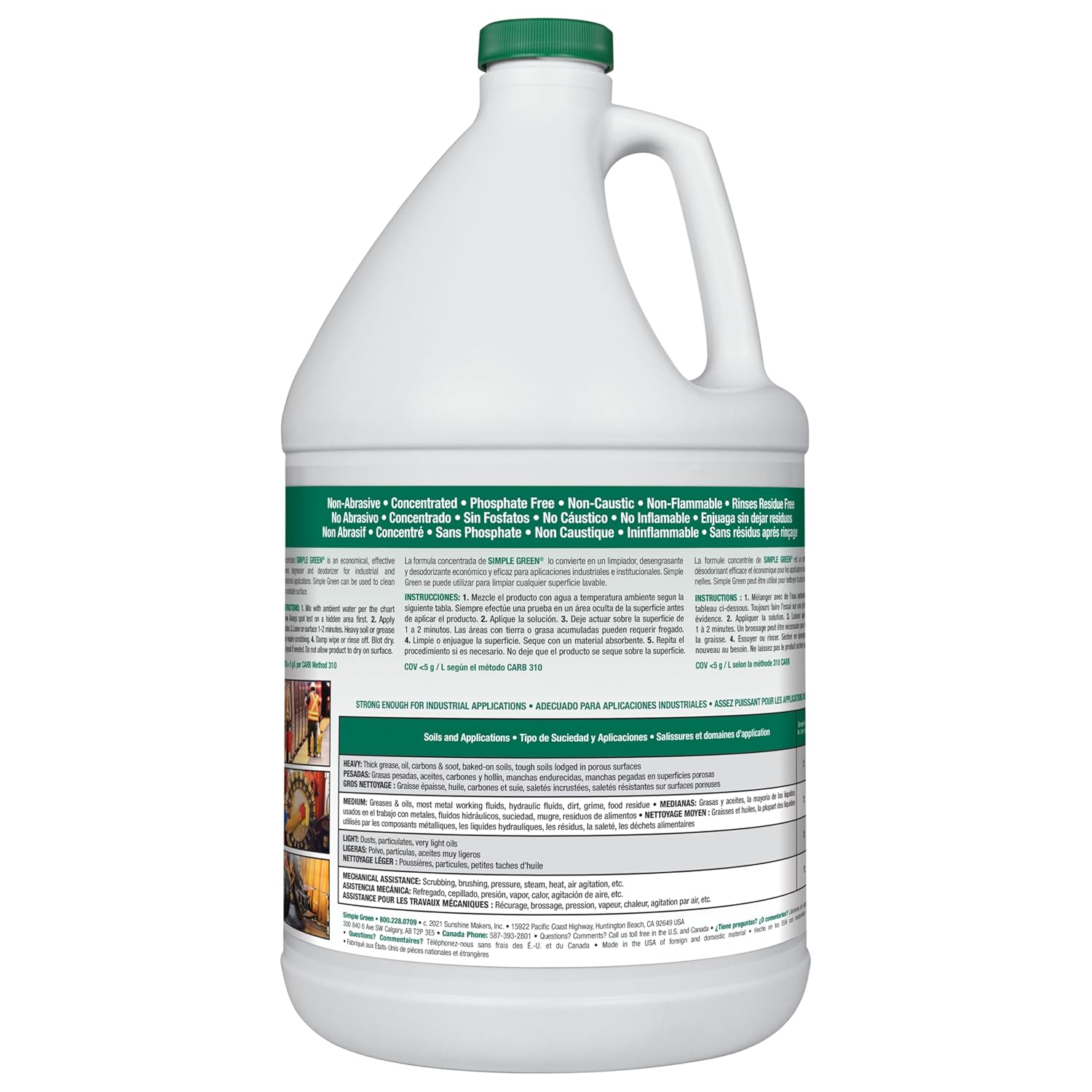
Simple Green Industrial (the concentrate in the yellow-label gallon or 5-gallon pail, distinct from the original household formula) is built around an alkaline, surfactant-based platform with an explicit design goal of broad-surface safety. The Sunshine Makers Inc. Safety Data Sheet for the Industrial formula, revised 2024, lists the product as non-flammable, non-corrosive, and non-caustic at use-dilutions, with a concentrate pH Sunshine Makers documents at approximately 8.5–9.5. That moderate alkalinity is intentional: it allows the formula to clean effectively across a wide range of surfaces — including coated floors, polished stone, and painted equipment — without the surface-compatibility restrictions that come with higher-pH chemistry.
Simple Green Industrial Concentrate carries EPA Safer Choice certification. The EPA Safer Choice Program, administered by the U.S. Environmental Protection Agency, conducts ingredient-level review against defined hazard criteria covering aquatic toxicity, mammalian health, and environmental persistence before certifying a product. Per the EPA Safer Choice Program’s certified products list, Simple Green Industrial holds active certification as of the date of this writing. That certification matters concretely: if you’re bidding LEED-certified buildings, government accounts, or school contracts where chemical documentation is part of the RFP, Safer Choice is a searchable, auditable third-party signal — not a brand claim.
SMP13005
$9.98
In stock on Amazon
Check price on AmazonZep Industrial Purple: High-Alkalinity Degreasing Performance
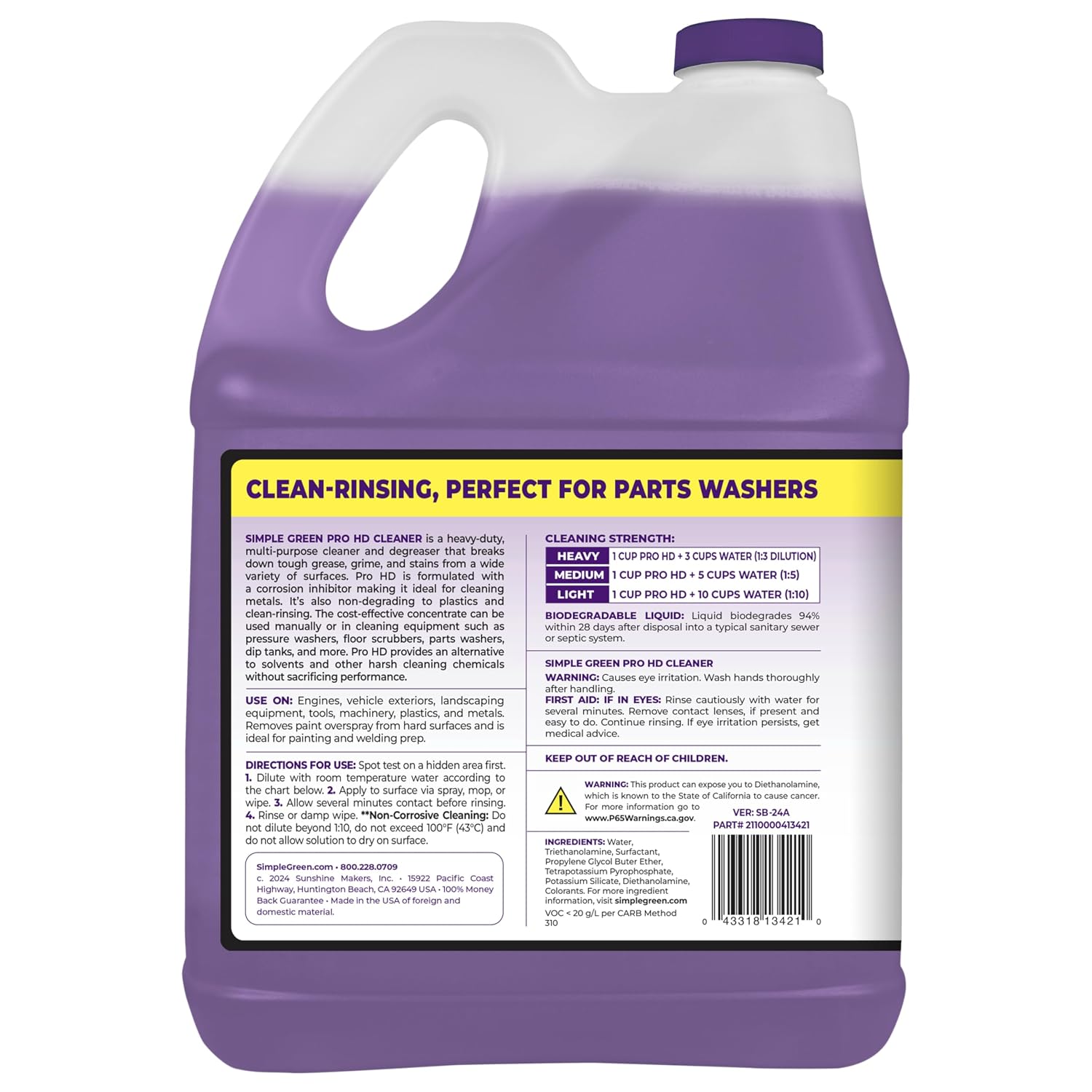
Zep Industrial Purple (their flagship heavy-duty degreaser concentrate, widely available in gallon and drum formats) takes a fundamentally different approach: higher alkalinity, a more aggressive solvent-surfactant blend, and an explicit pitch toward cutting heavy grease, oil, and industrial soils that a milder formula won’t touch efficiently. The Zep Inc. Technical Data Sheet for Industrial Purple, revised 2023, puts the product’s pH at approximately 12–13 in concentrate form — significantly higher than Simple Green Industrial.
High pH drives faster saponification of fats and oils, a process by which alkaline chemistry converts grease into a water-soluble compound that can be rinsed away. That’s exactly what you need in a commercial kitchen hood cleaning, a food-processing drain trench, or a fleet maintenance bay where petroleum-based soils are the primary contamination. The tradeoff is predictable: more surface restrictions (high alkalinity can damage anodized aluminum, certain coatings, and natural stone), and more PPE requirements documented under the Occupational Safety and Health Administration Hazard Communication Standard, 29 CFR 1910.1200, which governs how SDS documentation must communicate hazards to workers.
Zep Industrial Purple does not carry EPA Safer Choice certification. Zep positions this product honestly as a performance degreaser rather than an eco-certified formula, which is a legitimate product design choice — but operators bidding green-building or LEED-CI projects need to account for that gap in their chemical documentation.
Simple
$15.58
In stock on Amazon
Check price on AmazonReading the Two Formulations Together
The shorthand is this: Simple Green Industrial is a broad-spectrum maintenance cleaner with a safety and regulatory edge. Zep Industrial Purple is a high-alkalinity degreaser built for heavy contamination loads where Simple Green will underperform. Comparing them as if they’re equivalent products competing on the same axis is the primary mistake operators make when sourcing.
Zep
$8.78
In stock on Amazon
Check price on AmazonCost-Per-Use Math: Where the Numbers Actually Land
This is where operators consistently misjudge both products by comparing shelf price instead of diluted cost per gallon of ready-to-use (RTU) solution.
By the numbers (May 2026 street pricing, Grainger/Zoro):
| Product | Unit size | Street price (approx.) | Dilution ratio (general purpose) | Cost per RTU gallon |
|---|---|---|---|---|
| Simple Green Industrial | 1 gal concentrate | ~$18–$22 | 1:10 to 1:30 | ~$0.60–$2.20 |
| Simple Green Industrial | 5 gal pail | ~$75–$85 | 1:10 to 1:30 | ~$0.50–$1.70 |
| Zep Industrial Purple | 1 gal concentrate | ~$20–$26 | 1:8 to 1:32 | ~$0.63–$3.25 |
| Zep Industrial Purple | 5 gal pail | ~$80–$95 | 1:8 to 1:32 | ~$0.50–$1.90 |
Ranges reflect dilution ratio variation by soil load. Light-duty dilutions push cost-per-gallon down; heavy-duty (low-water) dilutions push it up. Prices sourced from publicly listed distributor pricing, May 2026.
At light-to-medium duty dilutions, the two products are nearly identical in cost per gallon of working solution. The divergence happens at heavy-duty dilutions, where Zep’s stronger concentration requirement (less water per ounce of product) means you’re spending more per gallon — but you’re also doing in one pass what might require two passes with Simple Green on a heavily soiled surface. That’s the math most operators miss: product cost per gallon is not the same as labor cost per job. If Zep removes kitchen exhaust hood buildup in 8 minutes that Simple Green requires 20 minutes to address, Zep wins the job-level cost analysis even if it runs $0.50 more per RTU gallon.
A note on drum economics: Both brands sell 55-gallon drums through Grainger and regional janitorial distributors. At drum pricing — typically 15–25% below pail pricing per gallon — Simple Green Industrial runs approximately $0.40–$1.50 per RTU gallon and Zep Industrial Purple runs approximately $0.45–$1.70, depending on negotiated distributor pricing. If you’re at 20 or more accounts with consistent chemical use, drum procurement paired with a proportioner system (a wall-mounted dispenser that automatically dilutes concentrate to the correct ratio) will reduce your per-gallon cost and eliminate employee over-use errors. Cleanlink.com’s coverage of dilution-control and chemical management best practices, published in Cleaning & Maintenance Management, 2024, consistently identifies over-dilution and under-dilution as the two largest drivers of wasted chemical spend in service operations — a finding that holds regardless of which product you standardize on.
Regulatory Standing and Green Claims: Verified vs. Marketing Language
This is an area where operators need to read carefully rather than take label language at face value, because the gap between regulated claims and marketing copy is wide on both products.
EPA Safer Choice certification is the only third-party signal in this product category with publicly defined criteria. The EPA Safer Choice Program’s certified products list is a searchable public database maintained by the U.S. Environmental Protection Agency. Simple Green Industrial Concentrate appears on that list with active certification. Zep Industrial Purple does not. For operators bidding school district, healthcare, or municipal cleaning contracts, this difference can appear explicitly in RFP language — and the inability to produce a Safer Choice certificate when it’s required is a disqualifying gap, not a minor documentation issue.
LEED and CIMS alignment: The ISSA Cleaning Industry Management Standard (CIMS) Green Building criteria, per the ISSA 2023 edition, requires that chemical products used on certified projects meet defined concentration and hazard thresholds. Simple Green Industrial satisfies those thresholds more readily than high-alkalinity degreasers. If CIMS certification is part of your business development strategy — increasingly common when targeting Class A commercial properties — your chemical documentation needs to align with those criteria, and that alignment is easier to demonstrate with EPA Safer Choice-certified products.
A practical caution on unregulated language: The terms “biodegradable,” “non-toxic,” and “environmentally friendly” are unregulated phrases under EPA labeling rules and carry no legal definition in this context. Both brands use versions of this language in consumer-facing marketing. Neither phrase constitutes a verified claim. EPA Safer Choice certification from the U.S. Environmental Protection Agency is the verifiable standard — always confirm certification currency through the EPA Safer Choice Program’s public records rather than relying on label copy, since certifications can lapse without immediate label updates.
Where Each Product Wins: The Decision Framework
After reviewing published specifications, Safety Data Sheet documentation from Sunshine Makers Inc. and Zep Inc., EPA Safer Choice Program certification records, ISSA CIMS Green Building criteria, and trade-publication coverage from Cleanlink.com and Cleaning & Maintenance Management, the pattern is consistent enough to support a clear decision framework.
Choose Simple Green Industrial if:
- Your account mix is primarily general commercial, educational, medical office, or residential premium — surfaces where a broad-spectrum, surface-safe formula reduces damage-claim risk and simplifies your chemical program.
- You’re bidding any contract where EPA Safer Choice certification or LEED-compliant chemistry is a stated requirement or competitive differentiator in the RFP.
- You want one primary concentrate that handles 80% of your job types at a predictable dilution without requiring extensive PPE for routine use.
- You’re standardizing on a proportioner system and need a formula with stable, consistent dilution behavior across your range of accounts.
Choose Zep Industrial Purple if:
- Your account mix includes commercial kitchens, food processing facilities, auto shops, fleet maintenance bays, or any environment with heavy grease, oil, or industrial soil loads where alkaline performance is the primary requirement.
- You’re pricing jobs by output (square footage cleaned per labor hour) rather than by time, and first-pass soil removal directly controls your labor efficiency math.
- Your team is trained on SDS documentation requirements and proper PPE protocols for high-alkalinity chemistry under OSHA Hazard Communication Standard 29 CFR 1910.1200 — not because the process is complicated, but because skipping that step with a pH-12 product is an OSHA compliance exposure.
- You are not competing for green-certification contracts and can invest the cost difference in higher dilution performance rather than certification documentation overhead.
The hybrid approach that operators at the 10–30 account scale frequently land on: Simple Green Industrial as the standard-line product across general accounts, Zep Industrial Purple as a specialty item carried specifically for kitchen hood cleaning, exhaust fan service, or fleet jobs quoted at a premium rate. This structure keeps your core chemical program simple, certifiable, and safe for broad deployment, while preserving the degreasing firepower for higher-ticket specialty work that justifies the chemistry cost and PPE protocols.
The Bottom Line
Both Simple Green Industrial and Zep Industrial Purple are legitimate, well-documented industrial concentrates with clearly published Safety Data Sheets and technical specifications. Neither is universally better — they’re optimized for different contamination profiles and different regulatory environments. The operator who standardizes on the wrong one either leaves money on the table in heavy-degreasing jobs (Simple Green in a commercial kitchen exhaust system) or takes on unnecessary regulatory complexity and surface-damage risk in general commercial work (Zep Industrial Purple on polished stone or coated surfaces).
If your current contract mix is general commercial with occasional specialty jobs, Simple Green Industrial at drum pricing with a proportioner system represents the lower-risk, higher-documentation standard for most operators. If you’re building a kitchen exhaust, fleet, or industrial services niche, Zep Industrial Purple’s performance math will justify the higher-alkalinity overhead. Price the jobs to the chemistry, not the other way around.