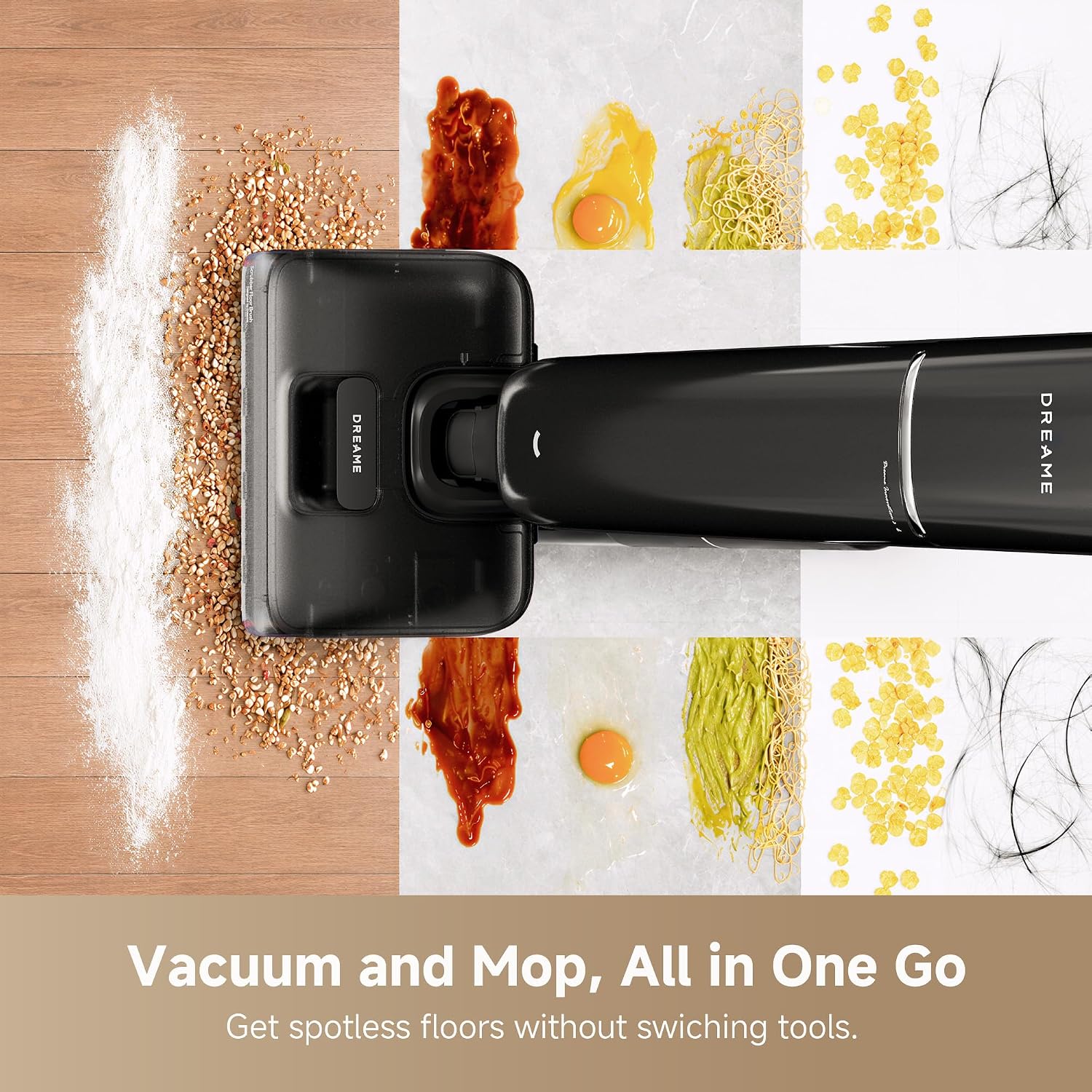
A wet-dry vacuum mop combo — sometimes marketed as a “floor washer” or “self-cleaning mop vac” — is a single machine that vacuums up loose debris and then lays down a cleaning solution to mop the floor, all in one pass. Think of it as replacing your vacuum-then-mop two-step with one tool that handles both. For apartment dwellers and residential cleaners, the appeal is obvious: less gear, less time, one device to store. For operators running residential or light-commercial contracts, the pitch is efficiency — fewer passes, lower labor minutes per square foot. But the spec sheets on these machines skip over the details that actually determine whether they deliver on that promise. This guide breaks down exactly what those gaps are, where the real trade-offs live at each price tier, and how to read a combo’s numbers in a way that maps to your actual floor type and job scope.
| EDITOR'S PICK[NARWAL S20 Pro Cordless Vacuum](https://www.amazon.com/dp/B0D9Q1CQMF?tag=greenflower20-20)… | Mid-tier[LEVOIT Cordless Vacuum Cleaner](https://www.amazon.com/dp/B0DQKQ3F2C?tag=greenflower20-20)… | Budget pick[Shark PowerPro Plus Cordless St](https://www.amazon.com/dp/B0F2GRSBY2?tag=greenflower20-20)… | |
|---|---|---|---|
| Mop function | ✓ | ✗ | ✗ |
| Self-cleaning | ✓ | — | — |
| Runtime | — | 60 mins | 50 mins |
| Filter type | — | HEPA | HEPA |
| Floor detection | — | — | ✓ |
| Price | $299.99 | $219.99 | $199.99 |
| See on Amazon → | See on Amazon → | See on Amazon → |
The Three Spec-Sheet Gaps That Bite Buyers First
Manufacturers are good at advertising suction power, tank capacity, and run time. They’re quieter about three factors that matter more in practice.
1. Dirty-Water Tank Separation (or the Lack of It)
The most important structural difference between combo models — and the thing the marketing page buries in footnotes — is whether the machine uses a single-tank or dual-tank design.
A single-tank machine stores clean solution and collects dirty water in the same reservoir, or uses passive gravity separation with no physical wall between them. A dual-tank design keeps them fully isolated: clean water and cleaning solution on one side, dirty water on the other.
Why does this matter more than suction power? Because on a single-tank machine, you’re effectively mopping with increasingly diluted, increasingly dirty water as the run progresses. On a 1,500-square-foot job, the floor you finish last is being cleaned with a slurry of whatever came off the first 1,200 square feet. Reviewers at Good Housekeeping Institute flag this as the primary reason single-tank combos score lower on soil removal than their suction specs would predict — the floor looks clean until it dries, and then you can see the residue pattern.
The decision rule: For jobs over 600 sq ft, or any floor with meaningful grit load (commercial entryways, kitchens, pet households), dual-tank is the minimum viable spec. Single-tank designs are defensible only for daily touch-up passes on already-clean hard floors in residential settings.
2. Solution Flow Rate vs. Suction Balance
Every wet-dry floor combo has to manage a tension: lay down enough solution to lift soil, but vacuum it back up fast enough that you’re not leaving a wet film. Manufacturers publish suction in Pa (Pascals) or sometimes airwatts — a measure of suction power that accounts for both vacuum pressure and airflow volume. What they rarely publish is the solution flow rate in mL/min and how it was calibrated against that suction spec.
The problem shows up most on luxury vinyl plank (LVP) and sealed hardwood, where excess moisture sitting in seams causes long-term damage. A machine rated at 18,000 Pa suction sounds impressive, but if the mop pad is saturating the floor faster than the vacuum path can recover it, you’re still over-wetting.
Per Cleanlink’s commercial floor care productivity benchmarks, the effective standard for hard-floor maintenance in commercial settings is that recovered moisture should account for at least 85–90% of the solution dispensed in a single pass. That number almost never appears on a consumer-facing spec sheet. What you can look for as a proxy: operator reviews that specifically mention drying time. If a machine’s reviews consistently note “floor is dry in under 30 seconds after a pass,” the balance is likely working. If reviewers report visible streaking or a damp floor for 2+ minutes, the flow rate is outrunning the suction.
3. Self-Cleaning Cycle Effectiveness (and What It Actually Cleans)
Most current-generation combos (2023–2026) include a “self-cleaning” mode that flushes the brush roll and internal pathways with clean water at the end of a cycle. This feature is marketed aggressively and matters genuinely — a dirty brush roll re-deposits soil on the next use and becomes a bacteria reservoir quickly. But the spec sheet rarely distinguishes between two very different implementations:
- Brush-roll flush only: Clean water runs over the rotating brush for 20–30 seconds. Removes loose debris from the bristles. Does not sanitize. Does not reach the internal recovery channel.
- Full-path flush with heated drying: Clean water is pushed through the entire wet pathway, including recovery channels, and the machine then runs its motor to air-dry internal surfaces. Significantly reduces biofilm risk.
The ISSA Cleaning Industry Management Standard documentation on floor care equipment notes that equipment sanitization protocols require either chemical disinfection or heat/UV treatment to meet the threshold for microbial load reduction — a brief cold-water flush does not. For residential use, that distinction is mostly cosmetic. For operators handling healthcare-adjacent or food-service contracts, it’s a compliance issue.
By the Numbers: What Each Price Tier Actually Buys You
| Price Range | Tank Design | Typical Suction (Pa) | Self-Clean Type | Realistic Floor Coverage |
|---|---|---|---|---|
| $80–$180 | Single-tank | 8,000–14,000 Pa | Brush flush only | 400–700 sq ft per fill |
| $180–$350 | Dual-tank | 14,000–20,000 Pa | Brush flush + partial path | 700–1,200 sq ft per fill |
| $350–$600 | Dual-tank | 18,000–27,000 Pa | Full-path flush, some with heat dry | 1,200–2,000+ sq ft per fill |
| $600+ (commercial-grade) | Dual-tank, metal chassis | 22,000–35,000 Pa | Full-path flush, HEPA-rated exhaust | Continuous use, operator-dependent |
Sources: published manufacturer specs aggregated from product listings; Consumer Reports vacuum reliability survey data, 2024.
Floor-Type Matching: Where Combos Excel and Where They Fail
Sealed Hardwood and LVP: The High-Stakes Category
These are the floors where a misconfigured combo causes the most expensive damage. Both sealed hardwood and LVP are moisture-sensitive at the seam level even when the surface appears impervious. The spec sheet tells you nothing about the machine’s default solution volume on a “standard” cleaning mode.
Owners of mid-range combos on flooring forums consistently report that the “standard” mode on many $150–$250 machines deposits 20–30% more solution than the manufacturer’s own floor care guidance recommends for hardwood. The “low moisture” or “hard floor” mode — often a secondary button not prominently featured in the marketing — is the one that should be the default for these surfaces.
Decision rule: Before committing to any combo for sealed hardwood or LVP, verify that a reduced-moisture mode exists and that it’s independently selectable, not buried in a menu. If the spec sheet only mentions one cleaning mode, assume it’s calibrated for tile.
Tile and Grout: Where Combos Underperform
Tile is the most forgiving surface for moisture but the least forgiving for brush-roll geometry. Grout lines require either a stiff-bristle scrub or a pad that conforms to the texture — flat rotating brush rolls, which are the standard design on most combos in the $150–$400 range, ride over grout lines without meaningful contact.
Good Housekeeping Institute evaluations of hard-floor combos consistently score them lower on grout-line cleaning than on smooth-surface cleaning, regardless of price tier. For facilities with significant tile and grout (commercial kitchens, restrooms, entryways), a dedicated walk-behind scrubber — even a compact one — will outperform any vacuum-mop combo on grout cleaning. The combo’s value proposition collapses on that surface type.
Commercial Entryways and High-Traffic Zones
This is where operators scaling from residential to commercial contracts often over-rely on combos. A machine rated for 1,500 sq ft of residential use will reach that spec under residential soil load conditions — light dust, typical foot traffic. Per Cleanlink’s productivity benchmarks, commercial entryways at 50+ daily occupants generate roughly 3–5x the particulate load per square foot of residential interior space.
Running a residential-grade combo in a commercial entryway context will degrade brush roll life by an estimated 40–60% versus the rated lifespan, and will require tank dumps 2–3x more frequently than the spec sheet implies. If you’re bidding a commercial contract, either spec a commercial-grade machine ($600+) or build in additional labor time for the tank-dump cycle — and price accordingly.
Chemistry Compatibility: The Spec Sheet’s Biggest Omission
Almost no combo manufacturer publishes a comprehensive list of approved cleaning solution chemistries. Most say “use our branded solution or a pH-neutral floor cleaner.” That’s not legal language or a warranty voider in most cases — it’s covering their upsell on proprietary solution packs.
What actually matters for the machine’s longevity and your floor’s finish:
- pH range: Combos with rubber seals and soft-touch brush rolls are degraded by solutions above pH 10 or below pH 5 over repeated use. Most commercial degreasers run pH 11–13. Using them in a combo machine will shorten seal life. EPA Safer Choice-certified floor care products are generally formulated at pH 7–9, which is safe for most machine interiors and most floor finishes. Checking the EPA Safer Choice product list for floor care chemistry is a five-minute step that most buyers skip.
- Foaming agents: Solutions with high-foam surfactants will cause overflow in the dirty-water tank and can backflow into the motor housing. Low-foam or no-foam formulations are specified for all machine-dispensed floor care. This is a CIMS-documented standard per ISSA floor care guidance — the spec sheet for the machine won’t tell you this, but it’s a real failure mode.
The “If X, Then Y” Decision Frame
You’ve read the spec sheet and you’re comparing two or three machines. Here’s the filter that cuts through:
If your primary surface is LVP or sealed hardwood → require a selectable low-moisture mode and dual-tank design. Suction Pa matters less than moisture control.
If you’re running jobs over 1,000 sq ft per visit → the single-tank market under $200 is a cost trap. Labor time re-doing streaky floors erases the equipment savings within 2–3 months.
If you’re bidding commercial accounts with tile and grout → don’t spec a combo as your primary floor tool. Use it for smooth-surface maintenance passes; budget for a dedicated scrubber on grout areas.
If chemistry flexibility matters (you want to use your own bulk solutions) → confirm pH compatibility and foam profile before the machine arrives. EPA Safer Choice-listed floor care products are the lowest-risk default.
If self-cleaning cycle hygiene matters for your client type → the brush-flush-only implementations in the sub-$200 range won’t meet a reasonable sanitation standard for healthcare-adjacent or food-service accounts. Either move up to a full-path flush model or build a manual sanitization step into your post-job protocol.
The combo category has matured enough that genuinely good machines exist across the $200–$500 range for residential and light-commercial work. But the spec sheet was written to sell the machine, not to help you match it to your job. Reading the gaps — tank design, moisture balance, self-clean depth, chemistry compatibility — is where the real due diligence lives.